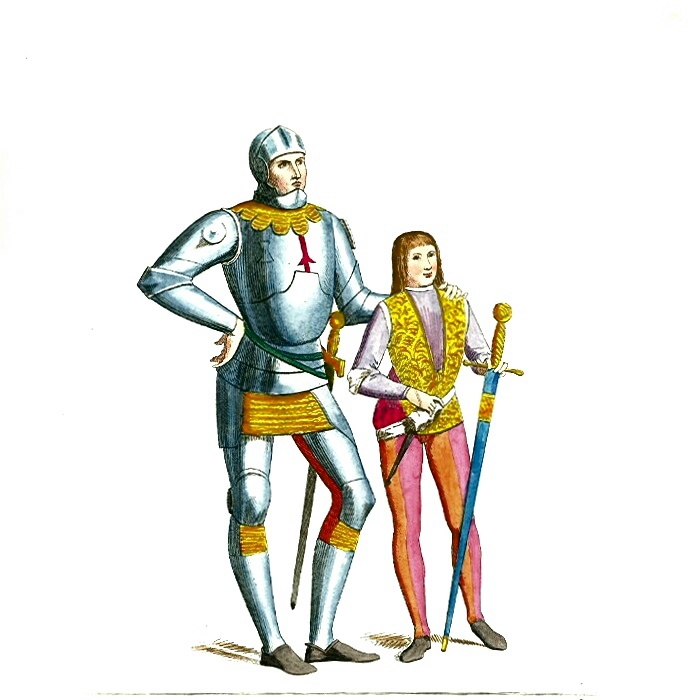
The Honest Knight
There once was, in France long ago, a poor knight. He had neither horse nor armour. But he was an honest man and his squire Hugo was very loyal to him. The knight, skilled with a lance, hoped to join a tournament in the city of La Haye, where he might win a purse of money. He and Hugo set off one evening toward the city.
“Do we have enough money to sleep at the inns,” asked the knight.
“Forgive me, m’lord,” replied the squire, “but we have only 12 pennies, which might be only enough to rent a horse at the tournament.”
“Then we will travel frugally, eat from the orchards, and sleep beneath the stars” said the knight with a smile. He didn’t mind: as a wandering knight he had often had to rough it, and he even liked the freedom of outdoor life.
That evening, while the knight made camp, Hugo went to fetch water. As he approached the stream, he spied three maidens bathing. But the maidens didn’t interest him; instead, it was the beautiful clothing they had hung on the trees. His eyes grew wide as he looked upon long gowns trimmed with golden thread, jewelled diadems, and lace gloves & underthings. Without being noticed, he slipped the treasures off the branches where they hung and stole away.
With pride and promise he showed the knight the riches he had acquired. But he should not have been surprised at the knight’s reaction:
“Knave! How dare you steal from these innocent girls!”
“But m’lord,” replied the squire “these women are clearly wealthy, to have such things. If we sell these clothes we would earn over a hundred pounds, which is more than you could earn in a lifetime of campaigns.”
“Earn? We would earn nothing but shame. I would not want wealth that came dishonestly. Show me where these maidens are: we will return their clothing immediately. They must be very worried to have been left without it.”
In those days, a squire had to do as his lord knight suggested, so Hugo did not argue further, and he led the knight to the stream.
When they arrived, the maidens were relieved: “Thank you, good sirs,” they said. “We could not have gone back to the castle without our clothes.” With a brief look to the other two and a twinkle in her eye, the eldest fae among them said “For your change of heart and honesty, we would like to reward you.” The knight tried to say he would accept no reward, but she made it clear she would not be denied.
“First, we promise that the road in front of you will always be free of rogues and bandits. Second, we promise that wherever you travel, you will be welcomed as a guest, with generosity, warm meals, and soft beds. And third, that if you ever suspect someone of lying to you, you can ask them any question and if they do not tell you the truth with their mouths, their bums will speak out and expose their lie.” The knight thanked the maidens, bowed courteously, and took his leave.
Later that evening, the knight and Hugo approached a town, on the edge of which was an inn. They could see the huge fire warming the common room, where many travellers ate, drank, and sang. Before they could continue, the door flew open and the owner came out to greet them. “Welcome, welcome, sir knight,” she bellowed, “you look like someone who could enrich our companies with stories and songs!”
“Forgive me,” said the knight, “but we haven’t enough to pay our fair cost.”
“Never mind that,” said the owner with a laugh, “I am a prosperous woman, and happy to offer you a place tonight!”
The knight and Hugo could scarce believe their ears, but accepted the offer. That night they ate their fill, sang with the company until the fire grew low, and slept in comfortable beds of straw.
The next morning, as they prepared to leave, one of the other guests–a wealthy clergyman in a rich fur cloak–rode up alongside them on a splendid horse. “Good sir knight,” he said with a slightly evil grin, “I can help you get to your destination, if you will join me?”
Hugo was suspicious of the man and leaned in close to the knight. “M’lord, he whispered,” we are not upon the road yet: he could be a bandit. Remember the promise of the maidens. Let me try to expose the lie.” The knight thought it silly, but nodded his approval. Hugo looked up at the tall figure on the horse and said “Are you really trying to help us?” The clergyman clenched his jaw and said nothing, when all of a sudden a voice rang out from beneath his buttocks:
“He is not! He is a bandit in disguise, and he aims to steal all you have as soon as he has you out of town! Beware, beware!”
Hugo and the knight were surprised, but not as surprised as the clergyman. “Sorcery!” he cried, sprang off his horse and dropped his cloak and weighty purse. The knight tried to help him collect his things, but the man ran away, never to be seen again. Hugo and the knight were amazed at their luck, standing there with their arms full of treasure and a fine horse, besides.
“Do you think those maidens were fairy-folk, m’lord?”
“I did not know before, but I am sure of it now.”
When the two arrived in La Haye, the gates to the lord and lady’s castle were thrown open to them. The lords and ladies gathered in the yard and welcomed them with songs and garlands, hugs and kisses. Their horse was led away to the stables, fed oats and beer, and brushed one hundred times. They were invited to dinner in the grand hall, where the lady of the castle announced that evening’s game:
“Each guest will tell a tale. Only they will know if it is true or not. The rest of us must guess which. If a story is exposed as a lie, the teller must pay a gold coin. If a tale fools us, the teller will earn ten gold coins.”
Though it was not his place to do so, Hugo could not resist. He jumped up and asked: “M’lady: if my lord knight can trick the teller himself to expose his lie, how will you reward him?”
The lady liked the idea of her game having a special rule, and said “squire, if your master can perform such a trick, he will get ten gold coins for himself!”
The first lord told a tale of bravely defeating a dragon. The knight asked “were you not afraid?” The man shook his head no, whereupon his bottom shouted “He was, he was! And it wasn’t a dragon, but just a little chicken!” Everyone at court roared with laughter.
That evening, one by one, the lords and ladies stood up and told their tall tales. And one by one, voices came out of their bumholes to decry their little tales as fictions:
“It’s not true!”
“She made it up!”
“Liar, liar, pants on fire!”
None of the storytellers could get angry at the knight, because it was their own bums that betrayed them. At the end of the evening, the lady of the castle delivered to the knight a purse with over a hundred gold coins, a sum so large he never needed to fight in tournaments again.
—
When people in France told stories like this, they did so to make fun of powerful people: imagine a great lord or lady with a talking bum. What if every time you told a tall tale, your bum shouted out the truth?
Great story Tommy. I love it! I sure know a guy in the states right now who’s bum I would like to hear….
Thanks, Marko! Hope the other stories are just as enjoyable.